The Moment Everything Stops
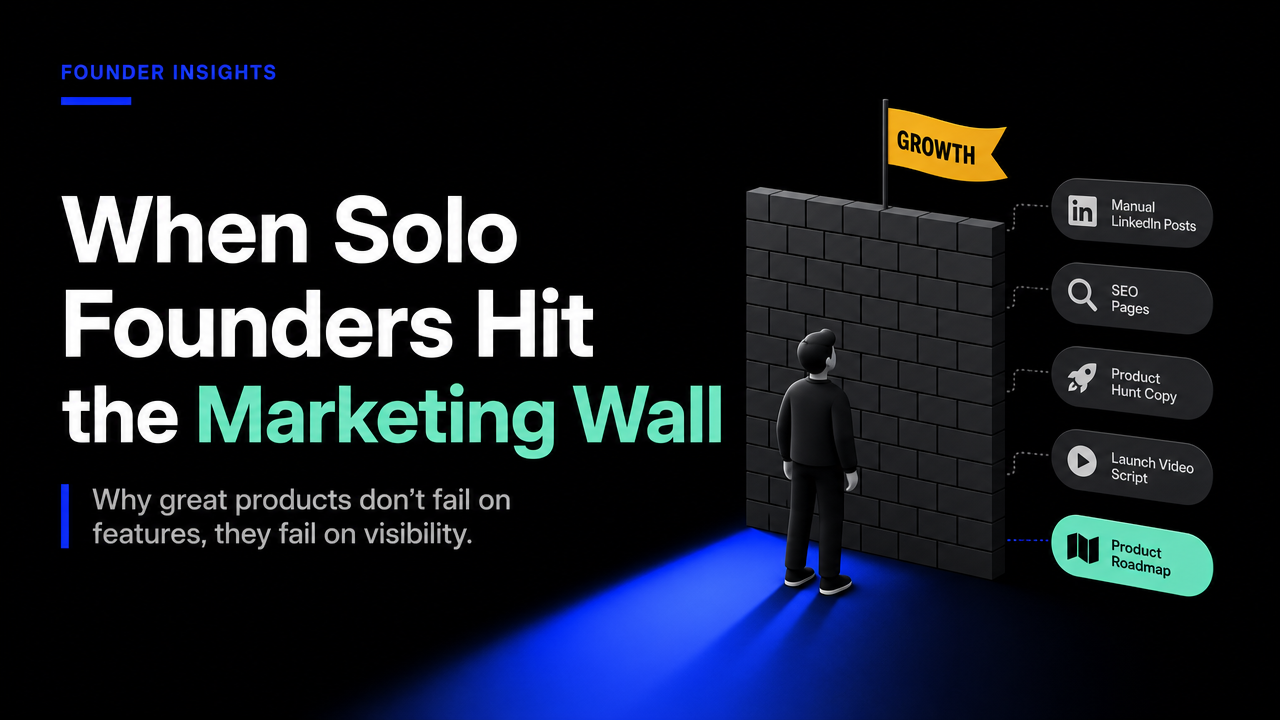
You ship a feature. It's solid. You know your users will love it. But no one finds it because you're still manually posting to LinkedIn, writing SEO pages, crafting Product Hunt copy, and managing a launch video script, all while your actual product roadmap sits gathering dust. This is the point where indie hackers confront a hard truth: you cannot do marketing alone without sacrificing the product you're trying to sell.
The problem isn't that marketing is hard. It's that marketing is *endless* when you try to run it manually. Every channel demands fresh content. Every launch needs copy written from scratch. Every blog post requires research, drafting, editing, and optimization. And every hour spent on marketing is an hour you're not shipping code.
Why Indie Hackers Think They Can Wing It
Most solo technical founders believe marketing is a checkbox, something to do *after* you build. You tell yourself: ship first, market second. But the market doesn't wait. By the time you're ready to promote, you've lost momentum. By the time you finish writing one blog post, two more topics that would rank have slipped away. By the time you schedule three LinkedIn posts, the engagement window has passed.
The trap is thinking you can treat marketing like code: build it once, it runs itself. Marketing doesn't work that way. It demands constant iteration, testing, and optimization. Product teams often stop marketing when they should start automating it because they're exhausted from the manual work, not because the work isn't valuable.
You end up stuck in a false choice: spend three hours a day on marketing and barely ship features, or ignore marketing entirely and have zero traction. Neither works.
The Real Cost of Doing It Solo
The obvious cost is time. But look deeper and you'll find something worse: opportunity cost. While you're writing SEO pages, someone else's product is ranking for the keywords you should own. While you're drafting a Product Hunt post, a competitor's launch is getting the attention your product deserves. While you're managing tool stacks and copy variations, you're not talking to users, finding product-market fit, or shipping the feature that actually moves the needle.
The hidden costs of manual marketing for product teams run deeper than hours lost. Manual marketing creates blind spots. You can't test multiple messaging angles because each one takes half a day to write. You can't publish consistently because you're juggling too many platforms. You can't optimize based on performance data because you haven't had time to check it.
For solo founders, this is especially brutal. You have no team to hand off tasks to. You have no marketing hire to delegate to. The work lands entirely on you. And when it lands on you, your product stalls.
What Needs to Change
The solution isn't to hire a marketing person (you can't afford it). It isn't to work 80-hour weeks (you'll burn out). It's to automate the marketing work the same way you'd automate repetitive code.
Most indie hackers don't think of marketing as automatable. They think it requires creativity, taste, brand voice. But much of marketing, especially for early-stage products, is pattern-matching and repetition. Generating blog content from your product's actual capabilities. Publishing to LinkedIn on a schedule. Creating SEO-optimized landing pages. Writing Product Hunt announcements. Ranking and optimizing existing content based on what actually performs. These tasks are repetitive enough to automate, but high-impact enough to matter.
When you remove the manual overhead, something shifts. You can publish consistently because the tool handles the heavy lifting. You can test multiple messaging angles because generating variations takes minutes, not hours. You can optimize based on performance data because the system surfaces what's working. And you get your time back to do what only you can do: build the product.
Automation as Your Marketing Co-Founder
The indie hackers shipping the fastest products aren't the ones grinding harder on marketing. They're the ones who automated the grinding. They've offloaded the tasks that don't require human judgment, content generation, scheduling, cross-posting, basic SEO optimization, so they can focus on strategy and product.
Automating your marketing stack doesn't mean losing control or putting bad content in the world. It means using AI to handle the labor-intensive parts, reading your codebase to understand what you're actually building, learning your writing style so generated content sounds like you, managing launches and directory listings, automating Product Hunt posts and launch videos, so you stay in the driver's seat while the repetitive work gets done.
Tools like Morket are designed exactly for this: to act as a marketing co-founder for solo and small technical teams. Instead of hiring someone, you get automation that understands your product, integrates with your existing tools (LinkedIn, CMS platforms, API endpoints), and turns a rough idea into a full launch in under 10 minutes.
The Realization That Changes Everything
The day you realize you can't do marketing alone isn't a failure. It's the moment you stop trying to be a one-person agency and start being a product founder again. It's the moment you recognize that marketing is a leverage point, and leverage is what automation gives you.
You don't need to become a marketer. You need to stop pretending marketing doesn't matter, and you need to stop grinding it manually. AI-driven customer engagement keeps product teams focused on building because it removes the friction between having a product and getting it in front of people.
The best products fail not because they're bad, but because no one knows they exist. And the best founders know that fighting marketing manually is a losing game. They automate it, own their time back, and ship faster as a result.