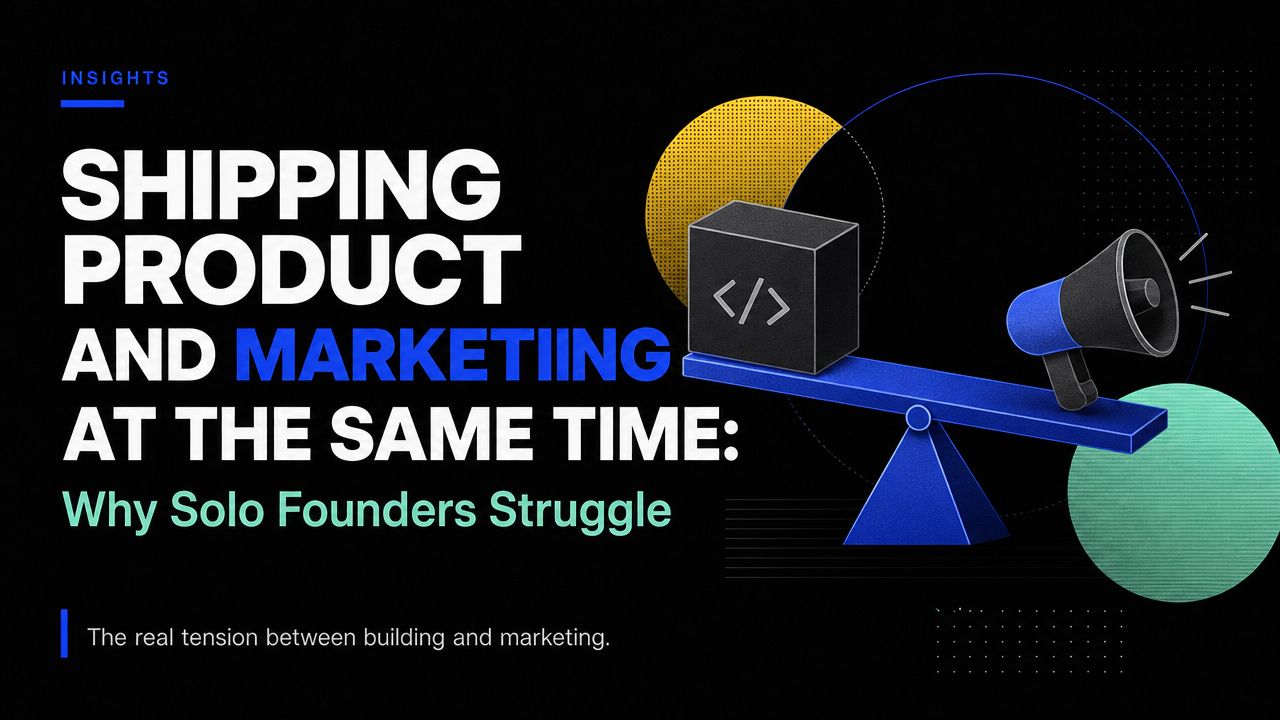
The Real Tension Between Building and Marketing
Solo founders face a genuine dilemma: the more time you spend on SEO marketing, the less time you have to ship. And the less you market, the fewer people know your product exists. This isn't a personal failure, it's a structural problem baked into early-stage startups.
When you're the only technical founder, your bandwidth is finite. A blog post takes hours. Writing a Product Hunt post takes more. Crafting LinkedIn content, managing directories, updating your website, it all piles up. Meanwhile, your codebase is waiting, bugs are piling, and features customers asked for last week still aren't built.
Why the Default Answer Doesn't Work for Indie Hackers
The traditional startup advice says hire a marketer. But at pre-product-market fit, with 50–200 users, that's not realistic. A freelancer costs money you don't have. An agency costs even more. And hiring a full-time marketer before you've proven the product has legs feels irresponsible.
So indie hackers default to doing both: building at night, marketing during the day. Or shipping fast and skipping marketing entirely, hoping Product Hunt or Twitter will carry them. Both strategies have a shelf life.
The cost of this split attention shows up in three ways:
- Inconsistent shipping: When marketing eats your calendar, features slip. When you prioritize the product, your content goes stale.
- Weak market signal: Without sustained visibility, blog posts, SEO, social presence, even a solid product stays invisible. Growth flattens.
- Decision paralysis: Every hour spent on marketing feels stolen from the product. Every hour on the product feels like a missed marketing opportunity.
What Makes This Harder Than It Looks
Marketing for a product-focused founder isn't like marketing for a marketer. You can't just follow a playbook because your product is still moving. The copy you wrote last month is outdated. The feature set customers need to hear about has changed. Your positioning has evolved.
Generic content tools don't help here. They can't read your codebase. They don't know what your product actually does or how it's different. So they generate content that feels off, either too generic or subtly wrong about your own product. You end up rewriting everything or scrapping it.
The real cost of manual marketing compounds quickly. Each piece of content that doesn't reflect your current product, positioning, or voice is a missed opportunity to convert someone who finds you.
How Automation Shifts the Equation
The answer isn't to hire someone. It's to automate the parts of marketing that don't need your judgment, so you can spend your human time on the parts that do.
The best marketing automation for indie hackers works like this:
- It learns your product context. The tool reads your codebase, your existing content, your positioning. It knows what you actually built, not what a template assumes.
- It generates content that matches your voice. If your writing is technical and direct, it doesn't sanitize it into corporate-speak. It learns your style and keeps it.
- It handles the recurring, high-volume stuff. Blog posts, LinkedIn updates, SEO-optimized pages, directory listings, launch posts, the things that build visibility over time but take hours to do manually.
- It integrates with your actual workflow. It publishes to your CMS, your LinkedIn, your website. It doesn't create work, it reduces it.
When this works, you get marketing that stays in sync with your product without stealing your attention from building.
The Math on Shipping Without Sacrificing Growth
The hidden costs of manual marketing compound over months. If you spend 3–5 hours a week on marketing tasks, writing posts, updating social, managing directories, that's 150–250 hours a year you're not shipping.
At typical startup velocity, that's enough time to ship 3–5 meaningful features or fix entire categories of bugs. For an early-stage product trying to find product-market fit, that's real opportunity cost.
Automation doesn't eliminate marketing work; it shifts it. Instead of spending 4 hours writing a blog post, you spend 30 minutes guiding the AI, reviewing the output, and fine-tuning it to match your product's current state. You still have judgment and final say. But the mechanical work, the writing, the formatting, the publishing, is done.
What Automation Can't Do (And Shouldn't Pretend To)
Clear boundaries matter. Automation handles production, not strategy. It can generate a lot of content fast, but you still need to decide what to write about, who you're talking to, and how it fits your growth goals.
Data-driven decisions matter more than intuition, especially as a solo founder. Automation should feed you signals, which content resonates, what searches your audience uses, which messaging converts, so you can make smarter bets on what to create next.
This is where performance ranking guides your content decisions. Instead of guessing what to write, you see what actually drives traffic and engagement, then create more of it.
Getting Unblocked: A Practical Starting Point
If you're feeling the squeeze right now, start small. Pick one thing that's eating your time: blog posts, LinkedIn presence, or SEO content. Automate that one thing well. Give yourself 4–6 weeks to see if the output quality is real and if it frees up meaningful hours.
The test is simple: Does the generated content require heavy editing, or can you publish most of it as-is? Are you getting traffic and engagement from it, or is it disappearing? Are you shipping faster?
If the answer to all three is yes, expand to another area. If not, adjust the tool or the inputs.
The indie founder's dilemma isn't unsolvable. It just requires different thinking, not hiring more people, but working smarter with the time you have.