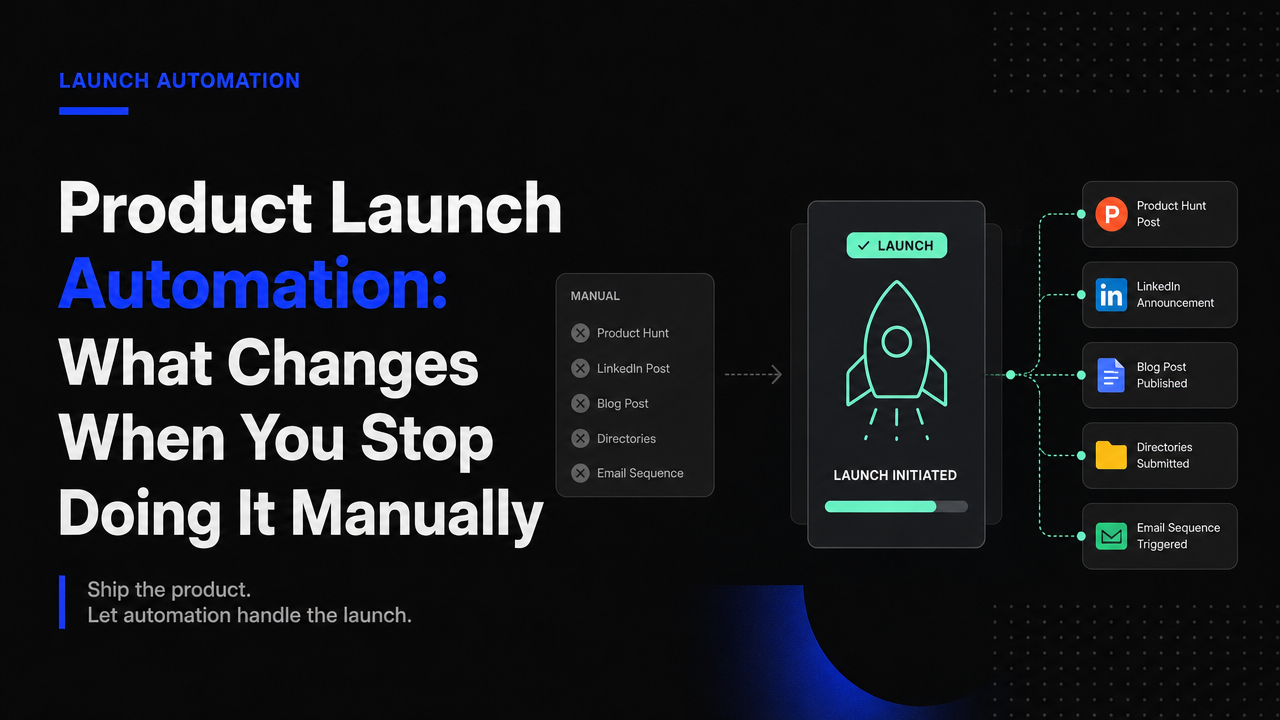
The Manual Launch Trap
Most indie hackers shipping a new product face the same problem: the code is ready, but the marketing feels like a second full-time job. You're juggling Product Hunt posts, LinkedIn announcements, blog content, directory listings, and email sequences, all while trying to stay focused on what you actually built. Product launch automation is the answer, but understanding what actually changes when you delegate this work to AI is what separates a smooth launch from another scrambled week of context-switching.
The friction starts simple. You need a Product Hunt post, so you write one from scratch. Then you realize your LinkedIn voice doesn't match your PH post. Someone asks about SEO, so you draft a blog post, but it doesn't mention your actual product features because you were writing fast. Each channel needs different messaging, different formats, different tones. Every piece of content requires you to context-switch back to marketing mode, even though you're supposed to be fixing bugs and shipping features.
What Automation Actually Solves
The core promise of Morket and similar automation tools is that AI can learn your product and your voice, then generate marketing assets that stay consistent and on-brand across channels. But the real value isn't just speed, it's coherence.
When you automate your launch, the tool reads your codebase and understands what you've actually built. It learns your writing style from existing content or conversations. It then generates Product Hunt posts, LinkedIn content, blog pages, and directory listings all from the same source of truth, your product. This means:
- Consistency across channels. Your messaging doesn't drift between platforms because every asset comes from one unified understanding of your product.
- Speed without shortcuts. Instead of trading quality for time, you're trading manual work for AI that knows your specific product, not generic templates.
- Data-aligned content. Tools that integrate with your analytics can rank and optimize content based on performance, so future pieces improve on what already works.
- Integration with your stack. If you're using Sanity, Webflow, or Framer for your site, the automation can publish directly to those platforms without manual uploads or formatting.
The Technical Founder's Specific Advantage
Indie hackers benefit more from launch automation than traditional marketing teams because the automation is designed around your workflow, not against it. You already think in code and systems. When a tool like Morket scans your repository, connects to your Google Analytics and Search Console, and offers API endpoints for custom integrations, it's speaking your language.
Most generic marketing tools ask you to fill out forms and input data manually. Automation tools built for technical founders let you connect your existing systems and let the AI extract what it needs. You don't lose control, you gain leverage. The tool augments what you're already doing, rather than replacing your judgment with a black box.
Setting up launch automation for a product team typically involves connecting your CMS, linking your analytics, and letting the AI learn from your repository and existing content. That's it. The automation then handles the repeatable parts, drafting posts, scheduling social content, generating blog outlines, while you focus on reviewing, editing, and shipping.
What Still Requires Your Input
Automation doesn't mean "set it and forget it." The tool generates, but you decide. You review Product Hunt posts before launch. You edit LinkedIn content for your voice. You prioritize which blog topics matter most. Content performance ranking helps guide which topics to focus on next, but you still choose your strategy.
The mental model shift is this: you're no longer writing everything from scratch. You're editing, reviewing, and directing a co-founder who handles the drafting and legwork. For solo founders, that's the difference between marketing feeling like a parallel job and marketing feeling like a tool you use between shipping cycles.
The Real Time Win
When you automate your marketing, you ship faster without sacrificing growth. You're not cutting corners, you're eliminating repetition. A manual product launch might take 20–30 hours across writing, formatting, scheduling, and publishing. Automation cuts that to 2–3 hours of review and refinement.
But the deeper win is protection from context-switching. Every time you step away from your product to write marketing copy, you lose the thread of what you were building. Automation keeps you in the code while your launch still happens. Your product and your marketing stay in sync because they're both running on the same rhythm, not competing for your attention.
For indie hackers trying to reach product-market fit with limited time and no marketing team, that's not just convenience. It's the difference between a launch that lands and one that gets lost in the noise.