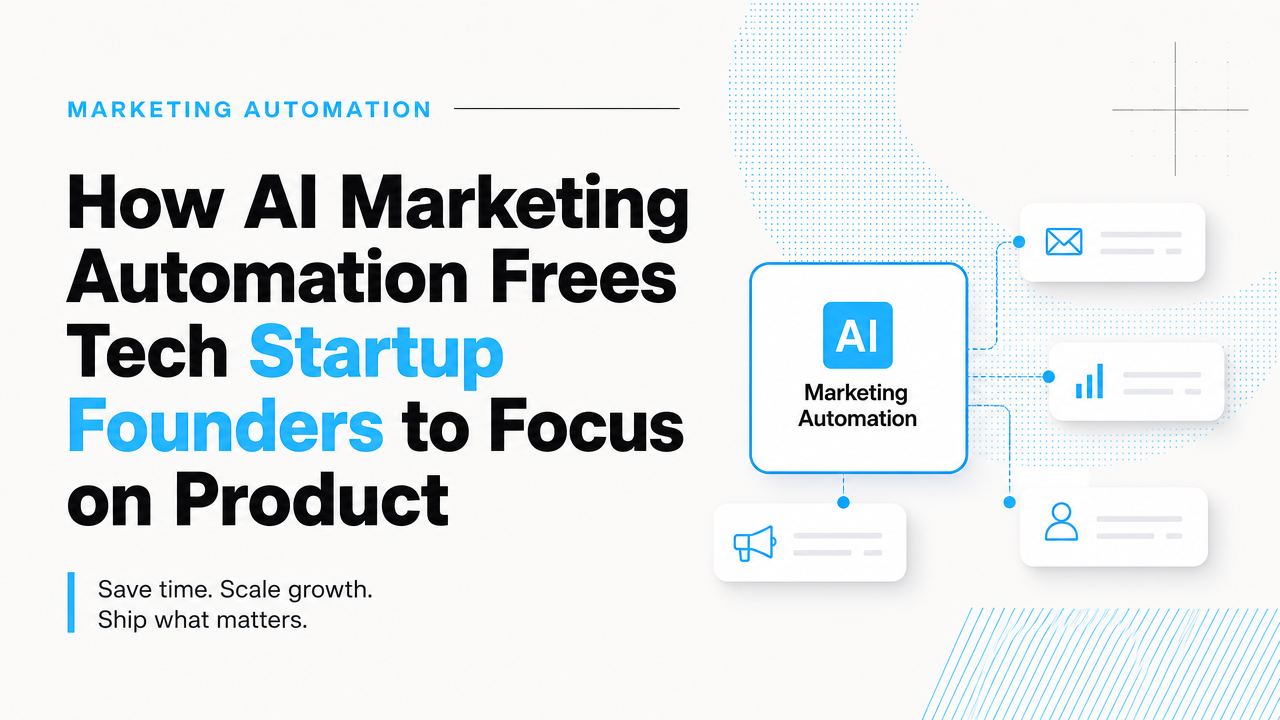
The Founder's Real Problem: Marketing Takes Time You Don't Have
Your tech startup needs marketing. But you also need to ship. When you're a founder balancing product development with growth, marketing automation becomes the difference between a launch that gains traction and one that lands quietly in a crowded market.
The tension is real: you know visibility matters, but every hour spent writing a Product Hunt post or optimizing a blog post is an hour not spent fixing bugs, talking to customers, or building the next feature. Most founder-led teams respond by doing one of two things, either they skip marketing entirely (costing them momentum), or they hire someone for the role (costing them runway). Neither is ideal when you're bootstrapped or running lean.
This is where AI-driven marketing automation lets product teams ship faster without sacrificing growth. Instead of choosing between building and marketing, you get a system that generates your assets, publishes them, and tracks what works, all while you focus on the product itself.
What AI Marketing Automation Actually Does (Beyond the Hype)
AI marketing automation isn't about replacing a marketer. It's about handling the repetitive, templatable parts of marketing so you can protect your maker time. Here's what the best tools do:
Content Generation at Scale
Writing a blog post from scratch takes 2–4 hours. You research keywords, draft, edit, optimize for SEO, format, add images. AI automates the first half. Tools like Morket's Blog Autopilot analyze your product, pull in performance data, and generate draft posts based on topics that are actually getting clicks in your space. You review, tweak the voice if needed, and hit publish. Total time: 20 minutes instead of 4 hours.
The same applies to social posts, directory listings, and even Product Hunt launches. The system reads your product description, understands your positioning, and outputs draft assets in your voice, not generic AI slop, but something you'd actually want to publish after a light edit.
Multi-Channel Publishing Without Manual Routing
Once you have a piece of content, distributing it shouldn't require logging into five different platforms. API integrations and direct connectors (like LinkedIn OAuth or Webflow CMS sync) let you publish once and have it land where your audience is. No copy-paste, no reformatting for each platform. A blog post you approve goes to your site, your CMS, and your social feeds in one action.
Performance Ranking That Guides Your Next Move
You publish content, but do you actually know what's working? Content performance ranking should guide every blog decision you make. AI tools track organic clicks, engagement, and conversion signals, then rank your posts by what's driving real results. This turns guesswork into a roadmap. Instead of writing randomly, you see that your "pricing strategy" post outperforms your "architecture overview" piece, so you double down on the former and adjust the latter.
This feedback loop compounds over time. Each piece of content you publish makes the next one smarter.
The Specific Payoff for Founder-Led Teams
You Can Launch Without a Marketing Hire
Hiring a full-time marketer too early burns cash and locks you into a salary commitment when you're uncertain about product-market fit. A bootstrapped founder using automation can maintain professional, consistent marketing presence without the overhead. Your launch still gets a Product Hunt post. You still get LinkedIn activity. You get SEO foundation. But you do it in 5–10 hours per month, not 40.
Your Messaging Stays Aligned With Product Changes
When you ship a new feature, your marketing should reflect it immediately. With manual processes, messaging lags. With automation tied to your product docs and API, as soon as you update your product description, your AI system can generate new asset variations that reflect the change. You're not playing catch-up.
You Have Data to Hand Off Later
When you do eventually hire a marketer or agency, you're not starting from zero. You have 6 months of performance data showing which content types, topics, and formats actually drive traffic and engagement in your space. That marketer can hit the ground running instead of spending a month on foundational research.
Why product teams stop marketing when they should start automating it is partly because the setup feels like friction. But tools like Morket are designed for quick onboarding, feed in your product info, connect your platforms, approve the first batch of drafts, and the system takes it from there.
The Real Mechanics: Where AI Actually Saves Hours
Let's ground this in real time allocation. A typical founder marketing week without automation:
- Monday morning: Write a LinkedIn post (45 min), format and post it (10 min)
- Wednesday: Research keywords, outline a blog post (90 min), draft (120 min)
- Thursday: Edit that post, optimize for SEO, add internal links (60 min), format in CMS (20 min)
- Friday: Create directory listings for Product Hunt, AppSumo, etc. (90 min)
- Total: ~7 hours
With AI marketing automation, the same week looks like:
- Monday: AI drafts LinkedIn post overnight based on your product description. You review and post (5 min)
- Wednesday: AI generates 3 blog post options based on performance data and your product. You pick one, tweak 2 paragraphs, approve (15 min)
- Thursday: Post goes live automatically via CMS integration, no manual formatting needed (0 min)
- Friday: AI pre-drafts directory listings. You fill in a few required custom fields, approve (20 min)
- Total: ~40 minutes
That's not 7 hours back in your week. It's 6.5 hours. For a founder, that's the difference between shipping a beta and not shipping it. That's customer calls instead of busywork. That's time to actually think about your next big feature.
The Integration Reality: It Needs to Work With Your Stack
The power of AI marketing automation only exists if it connects to where you're already working. Morket integrates with:
- LinkedIn (direct posting via OAuth)
- CMS platforms (Webflow, Framer, Sanity) for blog publishing
- API access for custom integrations with your own tools
- SEO and analytics data (via DataForSEO and other connectors)
This isn't a silo. It's a hub that fits into your existing workflow. You're not copying and pasting between six different tools. You approve content in one place, and it ripples out to every channel where your audience is.
When AI Marketing Actually Matters (And When It Doesn't)
AI marketing automation isn't a magic bullet. It works best when:
- You have a clear product story (the AI learns from what you give it)
- You have established product-market fit signals (so the AI's performance ranking is meaningful)
- You're willing to spend 30 minutes a week reviewing and approving drafts (not hands-off, not micromanaging)
- You care about consistency over perfection (a good-enough post published on schedule beats a perfect one you never wrote)
It's less useful if you're in pure stealth mode, if you have no clear positioning yet, or if your marketing strategy is entirely paid ads (automation handles organic content, not ad spend decisions).
But for most tech startups in the 0–2-year window, when you need credibility, visibility, and audience building but don't yet have headcount, automating your marketing stack is how you keep pace without burning out.
The Founder's Question: Is This Real or Oversold?
Real talk: no AI tool will write your founding story for you. It won't suddenly make your product go viral. But it will remove the busywork that keeps great products invisible. It will make sure you have consistent, SEO-friendly content in the market. It will give you performance data to make smarter decisions. And it will do all of this in the 5–10 hours per month that a lean founder can actually spare.
Getting started with Morket takes less than a day of setup, and most founders see the first batch of drafts within a few hours of connecting their product info. Try it. Approve or reject the first wave of assets, and see if you're spending less time on marketing while your brand stays visible.
That's not hype. That's just multiplication: more time on your product, same (or better) marketing output.