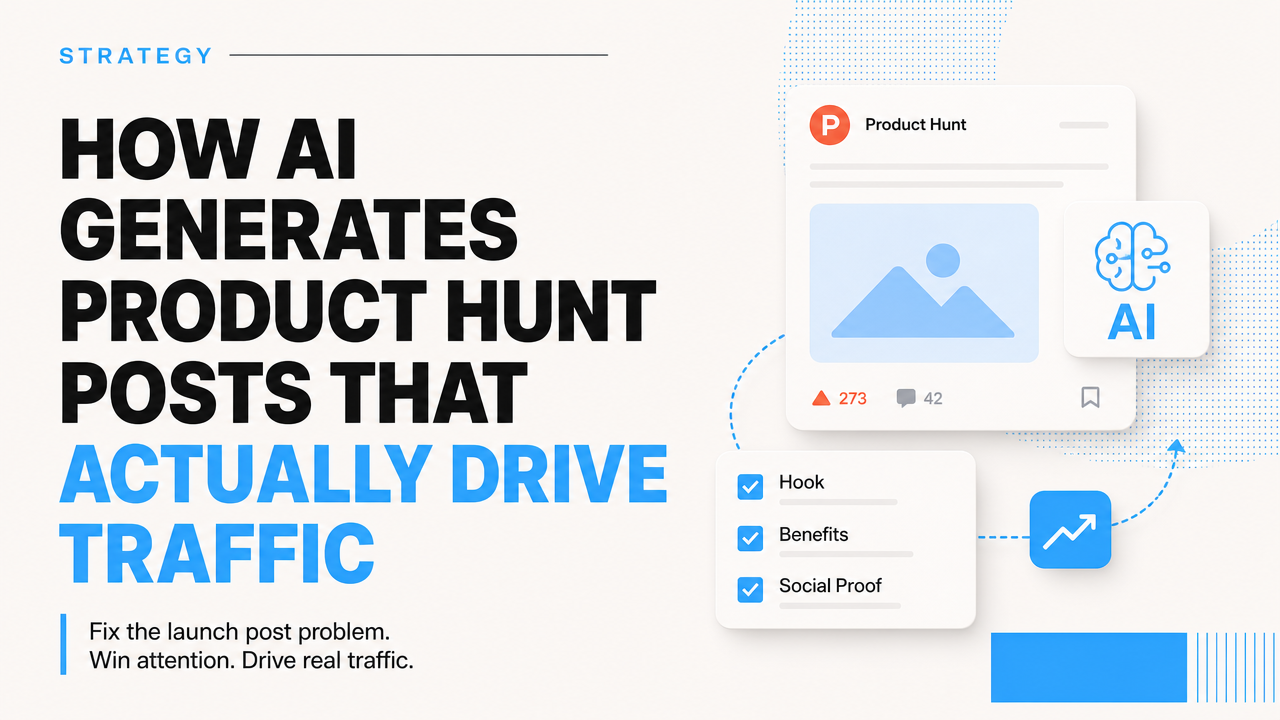
The Product Hunt Post Problem: Why Most Builders Get It Wrong
Most product launches on Product Hunt fail not because the product is bad, but because the launch post doesn't sell it. A Product Hunt launch post demands something most builders don't have: marketing instinct paired with product knowledge. You understand your product inside out. What you likely don't know is how to frame it in the 200-word description, headline, and tagline that will make hunters click, upvote, and share.
The problem gets worse when you're rushing. You're still shipping. You're fixing bugs. The last thing you want to do is spend four hours wordsmithing a Product Hunt post at 11 PM the night before launch. Yet the post is often what determines whether you hit the front page or get buried.
How AI Changes the Product Hunt Launch Equation
AI that understands your product, not just generic copy templates, can generate a polished, on-brand Product Hunt post in minutes. Here's what that process looks like with Morket:
- Product Analysis: Feed Morket your product information, feature list, and positioning. The AI reads and learns what makes your product different.
- Asset Generation: Morket produces a full Product Hunt post with a compelling headline, description, and tagline tuned for the Product Hunt audience.
- Brand Alignment: The copy reflects your voice and positioning, not a generic template. It captures the specific problem you solve and the outcome users get.
- Edit and Publish: You review, tweak, and approve before posting. Nothing ships without your sign-off.
The mechanic matters. Rather than asking you "What's your elevator pitch?" and filling in blanks, AI that has analyzed your full product description can spot the genuine differentiator, the thing that makes your product defensible, and lead with it.
What Makes a Product Hunt Post Perform
Product Hunt users are builders and operators. They're not looking for marketing fluff. They want clarity: What problem does this solve? Who is it for? Why should I care right now?
A strong post typically includes:
- A Sharp Tagline: One sentence that tells someone what you built. "Slack for design teams" or "Figma but for videos." If it takes two sentences, you don't have a tagline yet.
- A Clear Problem Statement: The first line of your description should make someone nod. "Building marketing assets takes weeks. You don't have weeks."
- The Specific Solution: Not "we automate your workflow." Rather, "we generate your Product Hunt post, launch video, SEO pages, and LinkedIn content in one session."
- Proof or Credibility: If you have users, testimonials, or a beta win, this is where it lives. Even a "used by 50+ product teams" anchor works.
- A Clear Call-to-Action: "Get started free" or "See the demo" gives hunters a next step beyond upvoting.
AI that has read dozens of successful Product Hunt posts and your specific product can spot these elements and weave them together in a way that sounds natural, not mechanical. The AI doesn't force buzzwords. It works with the actual shape of your product to find the honest story.
The Speed and Focus Win
When you use AI to automate marketing tasks like Product Hunt post creation, you don't just save an evening. You free yourself to do what matters most in the final hours before launch: testing the product, coordinating with co-founders, and preparing for inbound.
A launch day is chaotic. You're likely running Product Hunt yourself. You're answering comments. You're fixing edge cases that hunters discover. The last thing you need is to be stressed about whether your headline is tight enough. If the post is already solid and approved, you can focus on real-time product support.
This is where the AI marketing co-founder model matters. You're not hiring a contractor or learning copywriting. You're delegating a concrete task to a tool that can execute it end-to-end.
From Draft to Approved Post: The Workflow
Morket's approach keeps humans in control. The AI generates drafts. You review them. You can rewrite sections, adjust tone, add personal details, or completely reframe if the draft misses the mark. This hybrid approach respects that you know your product better than any AI, but you also benefit from a structured, professional starting point.
In practice, a common pattern is spending less time reviewing and tweaking an AI-generated post, rather than writing from a blank page. That's the real win: not full automation, but dramatically faster iteration with quality guardrails.
Why Generic Tools Fall Short
Standard copywriting tools or marketing automation platforms can generate a post, but they usually work at arm's length. They ask you questions and fill templates. They don't read your product documentation and understand the mechanisms behind what you built. So the post often sounds generic: applicable to any SaaS, any tool, any launch.
Morket reads your full product information, your positioning, features, use cases, target customer. That grounding means the AI can generate a post that's specific to your product and your market. It's the difference between "we help you automate marketing" and "we generate your Product Hunt post in 10 minutes so you can focus on shipping."
The Broader Launch Strategy
A Product Hunt post is one asset in a launch sequence. Many builders also need launch videos, SEO pages for their landing site, and LinkedIn posts to announce the launch to their network. Creating all of these from scratch, on launch eve, is unrealistic. But AI-driven marketing automation can accelerate product launches by generating multiple coordinated assets, all on-brand, all specific to your product, in parallel.
When your launch post, video description, and LinkedIn announcement all reinforce the same core message, hunters and external audiences get a coherent, polished impression. That consistency is hard to fake in manual, rushed creation. It's what AI orchestration buys you.
Real Outcomes: Goals of a Good Post
Goals of a good Product Hunt post include:
- A draft ready for review quickly, saving substantial time compared to manual writing.
- Copy that accurately reflects positioning because the AI analyzed the full product context.
- More time to handle launch day logistics, inbound, and product fixes rather than last-minute copy panic.
- A post that performs because it's specific, clear, and tuned to the Product Hunt audience, not generic.
The outcome is simpler launches and better first-day performance. Neither is guaranteed, but both are more likely when your launch post is tight, specific, and ready a day early.
Getting Started
If you're planning a Product Hunt launch, the first step is preparing your product information for Morket. That means documenting your core differentiator, key features, target customer, and the problem you solve. Then feed that into Morket, and the AI will generate your launch post. Getting started with Morket is straightforward, provide your product context, review the drafts, and publish when you're ready.
The goal isn't to remove you from the process. It's to remove the friction, so your launch post is solid, specific, and ready well before you need it.